Your pool service was supposed to come Tuesday. It’s Friday, the water’s starting to look a little off, and you’re wondering whether anyone actually showed up this week. Sound familiar? Weekly pool service in Puerto Rico typically includes water chemistry testing across 8-10 parameters, chemical adjustments, physical cleaning (skimming, brushing, vacuuming), and equipment inspection—all performed by a technician trained through programs like the PHTA Certified Maintenance Specialist program. The difference between a pool that stays crystal clear and one that becomes a recurring headache often comes down to what actually happens during those weekly visits.
Here’s the thing most pool companies won’t tell you: there’s no universal standard for what “weekly pool service” means. One company might test three parameters and skim the surface in twelve minutes. Another might spend forty-five minutes running comprehensive diagnostics and documenting everything. Both call it “weekly service.” Both charge you monthly. The results, though? Dramatically different.
This guide breaks down exactly what professional pool maintenance should include in Puerto Rico’s tropical climate—where water chlorination degrades faster than anywhere on the mainland, algae never takes a season off, and the difference between adequate service and proper service shows up in your water quality within days.
What Professional Water Chemistry Testing Actually Involves
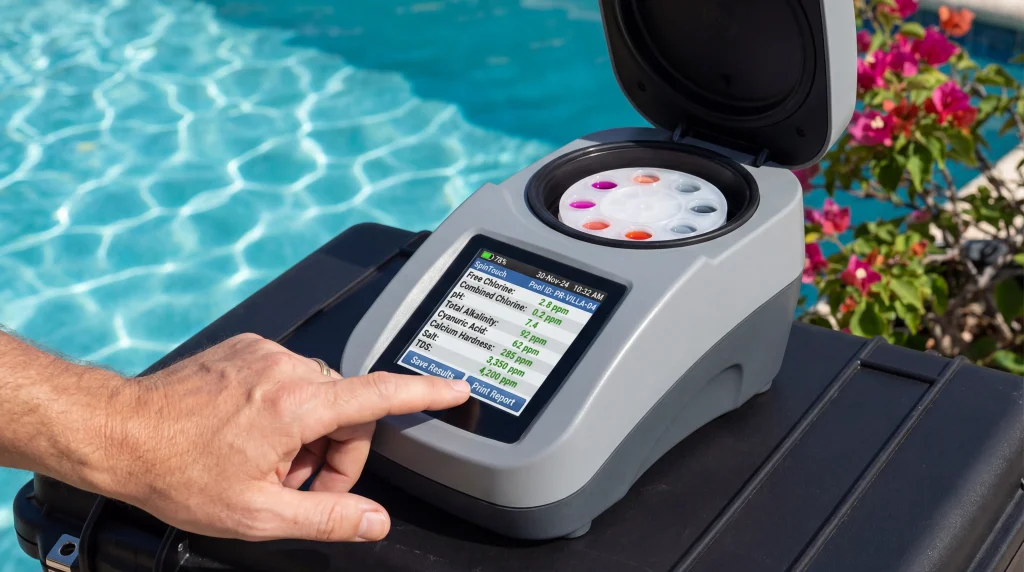
When a technician arrives for your weekly service, the first thing that happens—or should happen—determines everything else. Water testing isn’t just dipping a strip in the pool and eyeballing the colors. Professional testing involves measuring specific chemical parameters that interact with each other in ways that affect both water safety and equipment longevity.
At minimum, weekly testing should cover free chlorine, pH, and total alkalinity. But in Puerto Rico’s conditions, that’s not enough. Comprehensive weekly testing includes these parameters:
Free Available Chlorine (FAC): The active chlorine actually available to sanitize your pool. The CDC recommends pH 7.0-7.8 and chlorine of at least 1 ppm for residential pools, though we typically target 3-5 ppm in Puerto Rico due to accelerated chlorine demand from UV exposure.
pH Level: Measures water acidity on a scale from 0-14. Target range is 7.4-7.6 for Puerto Rico pools. When pH drifts above 7.8, chlorine effectiveness drops dramatically—hypochlorous acid, the actual germ-killing compound, converts to the much weaker hypochlorite ion. When pH falls below 7.2, the water becomes corrosive to equipment and uncomfortable for swimmers.
Total Alkalinity: Acts as a buffer preventing pH from swinging wildly. Target range is 80-120 ppm. Low alkalinity means pH becomes unstable and difficult to manage; high alkalinity makes pH hard to lower and can cause scaling.
Cyanuric Acid (CYA): This one matters more here than almost anywhere else. CYA protects chlorine from UV degradation. Without adequate CYA, Puerto Rico’s intense sunlight—UV index regularly hits 10-12—destroys unstabilized chlorine in 2-3 hours. We target 50-80 ppm, significantly higher than the 30-50 ppm recommended in temperate climates. Many mainland-trained technicians don’t adjust for this, which is why pools keep “using too much chlorine.”
Combined Chlorine: The difference between total chlorine and free chlorine. Combined chlorine indicates chloramines—the compounds that actually cause that “chlorine smell” and eye irritation. If combined chlorine exceeds 0.5 ppm, the pool needs shock treatment.
Calcium Hardness: Particularly important in areas with hard water. Low calcium causes water to become aggressive, pulling minerals from plaster and grout. High calcium leads to scaling on surfaces and equipment.
Total Dissolved Solids (TDS): The accumulation of everything dissolved in your pool water. As TDS rises, chlorine becomes less effective and water quality degrades.
Phosphates: Algae food. Even with proper chlorine levels, high phosphates can fuel algae growth.
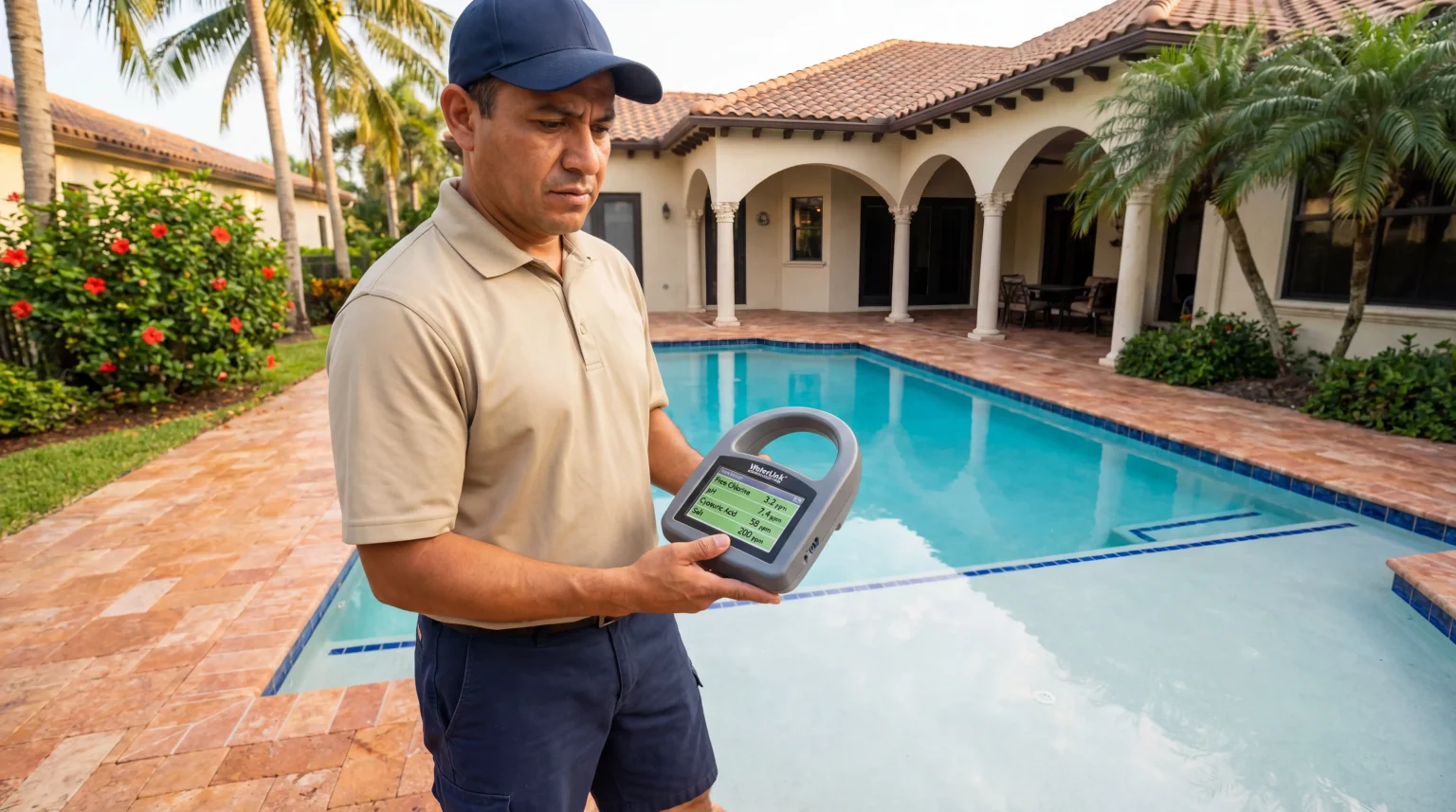
The testing method matters too. Color-matching test strips provide approximations. Reagent-based drop tests offer better accuracy. But photometric testing—using a device like the WaterLink SpinTouch—delivers laboratory-grade precision by measuring light absorption through the water sample, according to Pool & Hot Tub Alliance professional standards. That precision matters when you’re trying to understand why a pool keeps having problems despite “proper” chlorine levels.
The Chemical Balancing Process: What Happens After Testing
Testing tells you where the water chemistry stands. Chemical balancing brings it where it needs to be. This isn’t just dumping chemicals in and hoping for the best—there’s an order of operations that experienced technicians follow.
First, swimming pool sanitation requires addressing pH and alkalinity before chlorine. Adding chlorine to water with improper pH is largely wasted effort because the chlorine won’t work effectively anyway. Most technicians adjust alkalinity first because it affects pH, then fine-tune pH, then address sanitizer levels.
The amounts matter too. Chemical dosing should be calculated based on your pool’s actual volume, not estimated. A technician adding “about a gallon” of muriatic acid without knowing whether your pool holds 12,000 or 20,000 gallons isn’t doing chemistry—they’re guessing. Underdosing means the problem doesn’t get fixed. Overdosing can swing chemistry too far the other way, creating new problems.
In Puerto Rico’s climate, weekly chemical adjustments almost always include:
- Liquid chlorine or granular shock to replenish what UV has destroyed since the last visit
- Acid (muriatic or dry acid) to counteract the pH rise that occurs naturally from chlorine use and CO2 off-gassing
- Occasionally sodium bicarbonate to raise alkalinity if heavy rainfall has diluted the pool
- Cyanuric acid as needed to maintain protective stabilizer levels
What shouldn’t happen: dumping chemicals directly on pool surfaces. Concentrated chemicals can damage finishes. Proper technique involves adding chemicals while the pump is running, often through the skimmer, allowing the circulation system to distribute them evenly.
Physical Cleaning: Skimming, Brushing, and Vacuuming
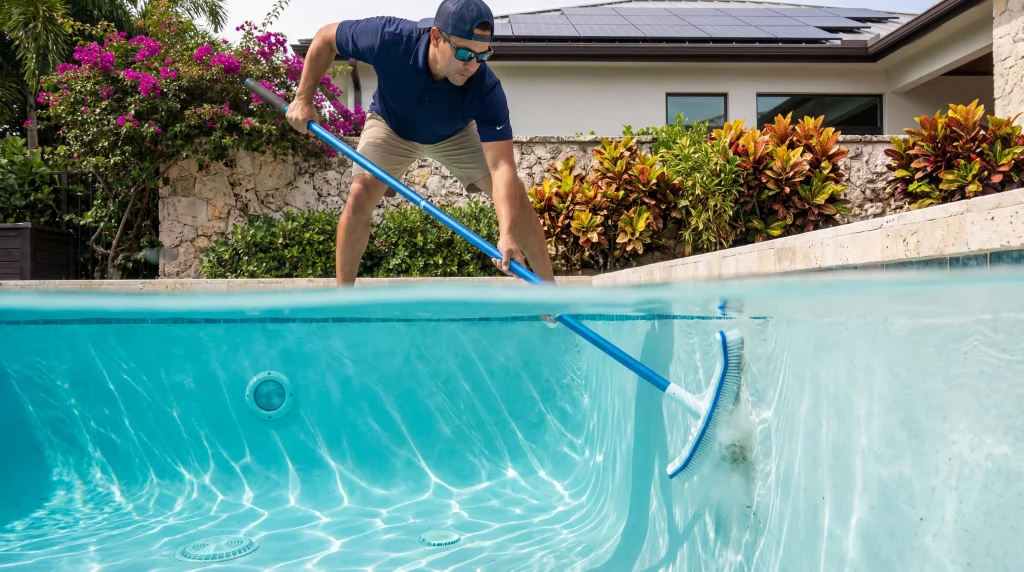
Chemistry handles what you can’t see. Physical cleaning handles what you can—and what will become a chemistry problem if you don’t remove it.
Surface Skimming: A leaf net removes floating debris before it sinks to the bottom and decomposes, consuming chlorine and feeding algae. Seems simple, but there’s technique involved. Working systematically from one end of the pool to the other ensures nothing gets missed. Skimming into the wind (if there is any) prevents debris from blowing back into the pool.
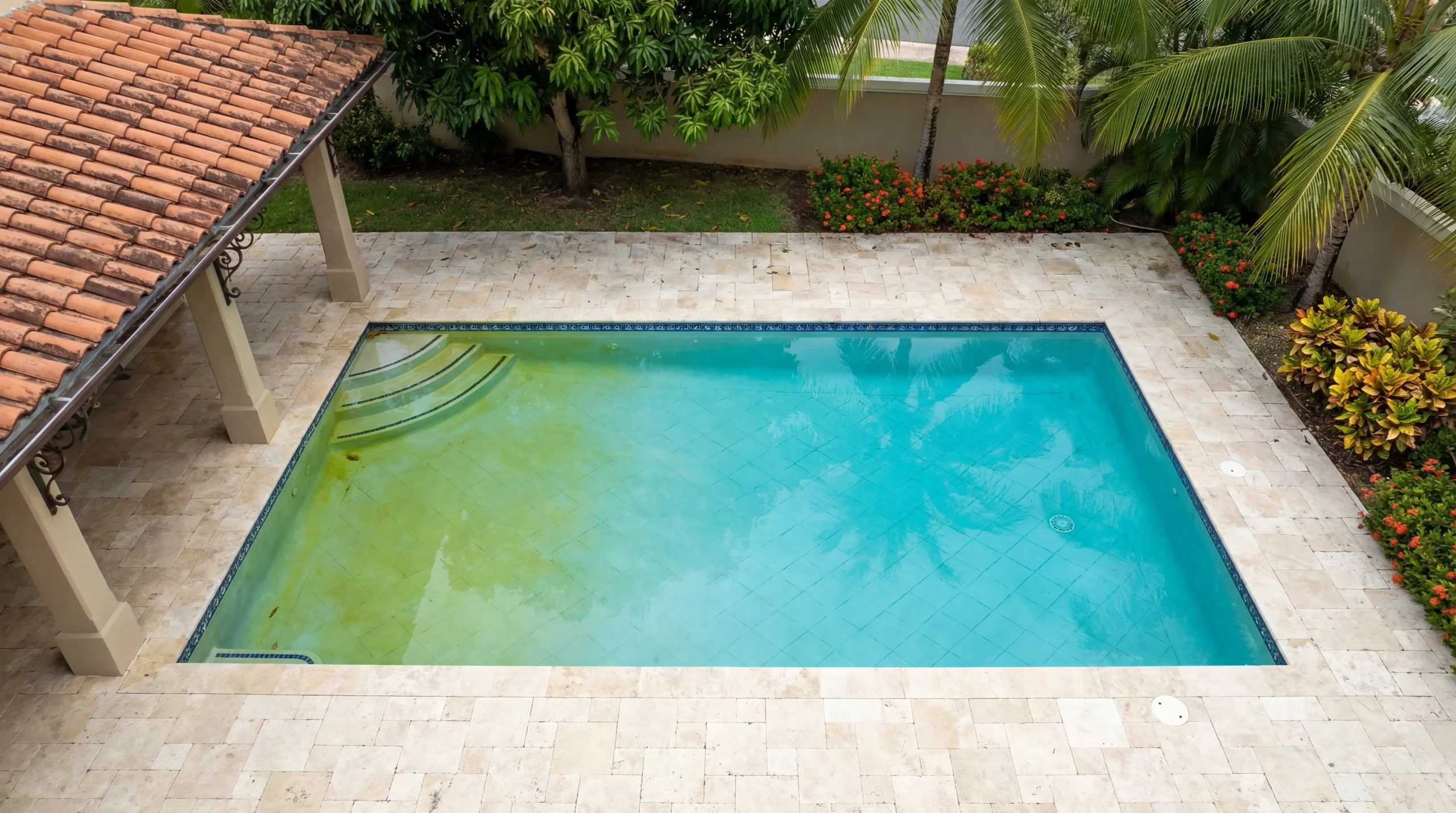
Brushing: This is the step most often skipped or rushed—and it’s one of the most important in tropical climates. Brushing does more than clean visible dirt. It disrupts the initial stages of algae growth before they become visible, removes biofilm from surfaces where bacteria can hide from chlorine, and circulates stagnant water in corners and steps where sanitizer levels can drop.
Proper brushing covers walls, floors, steps, ladders, behind lights, and inside crevices where algae loves to establish. A service visit where the tech only brushes “the spots that look dirty” is a service visit where algae is getting a head start for next week.
Vacuuming: Removes settled debris from the pool floor. Some service providers rely entirely on automatic cleaners for this and only manually vacuum when there’s visible debris. That approach works in pools with relatively low debris loads. In eastern Puerto Rico—where rain showers can blow in daily, bringing with them organic matter—manual vacuuming catches what automatics miss, particularly in corners and along the water line.
Equipment Inspection: Catching Problems Before They’re Expensive
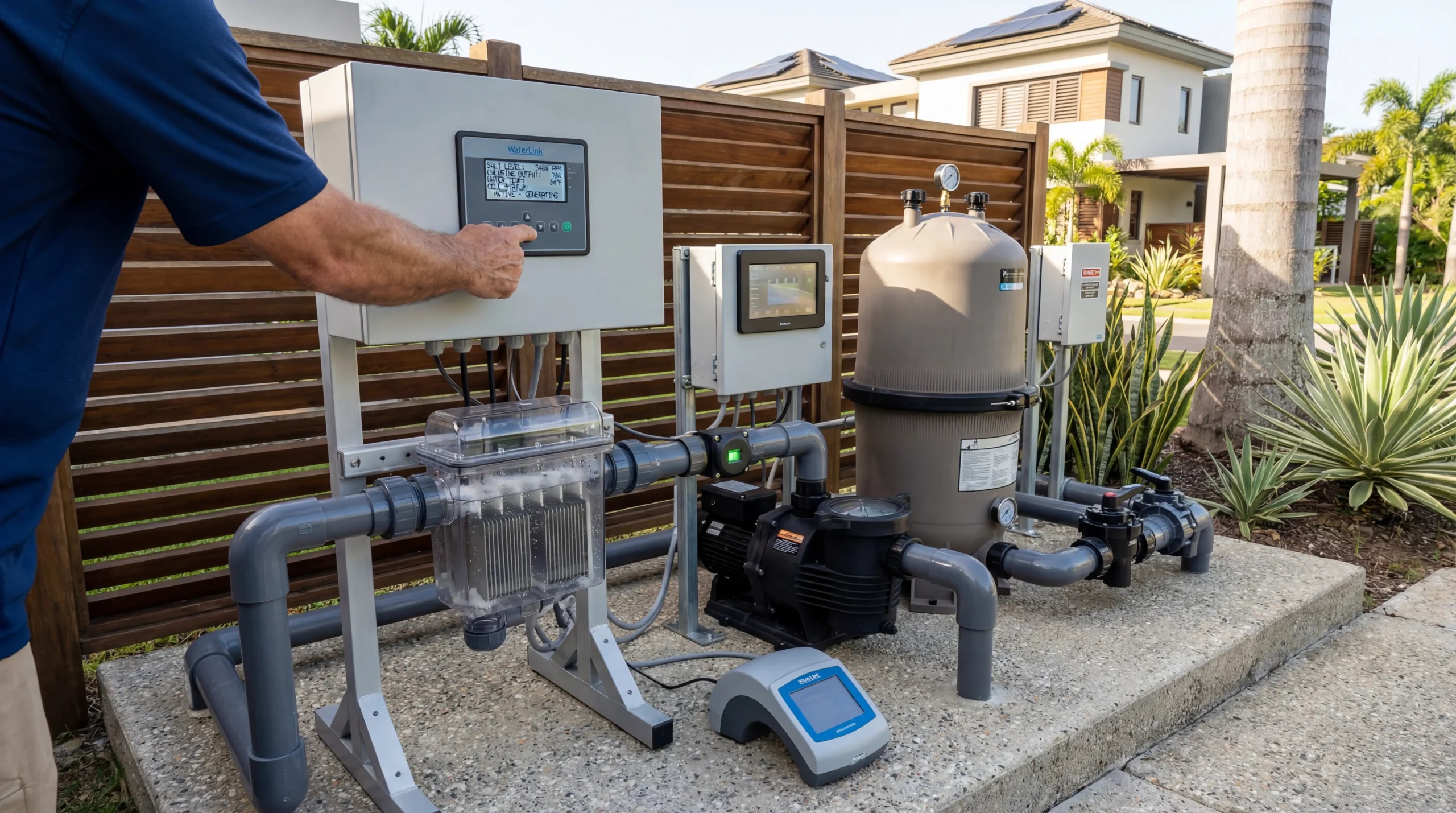
A pool’s mechanical systems work together: pump moves water, filter cleans it, chlorinator or salt cell sanitizes it. When one component underperforms, the others compensate until they can’t. By then, you’re facing a repair bill instead of a maintenance adjustment.
Weekly equipment checks should cover:
Pump and Motor: Is it running at normal operating sound? Any unusual vibration? Is the pump basket clear of debris? A clogged pump basket restricts flow, reduces filtration efficiency, and puts strain on the motor. Checking the basket—and emptying it—is basic maintenance that prevents expensive motor replacements.
Filter Pressure: Every filter has a pressure gauge. The reading when the filter is clean establishes a baseline. As the filter captures debris, pressure rises. When pressure reaches 8-10 PSI above baseline, the filter needs cleaning. A technician who doesn’t check the gauge won’t know the filter is restricting flow until the pool starts showing problems. Reference the Model Aquatic Health Code for industry standards on filtration and circulation.
Skimmers: Are the weir doors (the flaps at the skimmer opening) functioning properly? Are the skimmer baskets intact? A cracked basket lets debris through to the pump.
Return Jets: Are they all flowing properly? Weak flow from one return might indicate a line blockage. The direction of returns matters too—they should create circular water movement that helps debris reach the skimmers.
Salt Cell (if applicable): For saltwater pool systems, inspecting the cell for calcium buildup is essential. In Puerto Rico’s warm water, scaling can occur faster than mainland pools. A cell with heavy scale produces less chlorine even if the system shows normal operation.
Timers and Controls: Is the pump running on the correct schedule? Are automated chlorinators dispensing properly? A timer that’s lost its programming means the pool isn’t getting adequate circulation—which you might not notice until water quality degrades.
What Your Service Report Should Include
If your pool technician doesn’t leave documentation, you have no way to verify what was done, track trends over time, or provide useful information if problems develop. A proper service report includes:
- Date and time of visit
- All water chemistry readings (not just “okay” or “adjusted”)
- Chemicals added with quantities
- Physical cleaning performed
- Equipment status and any concerns noted
- Recommendations for the owner
- Technician name or ID
This documentation serves multiple purposes. It creates accountability—you can see exactly what was done. It allows tracking of trends—if pH is consistently high, that might indicate an underlying issue worth investigating. And it provides history for troubleshooting—when something goes wrong, knowing what the chemistry looked like over previous weeks helps diagnose the cause.
At Pristine Pools, our WaterLink SpinTouch system automatically generates detailed reports that clients receive after every visit. That’s not just good practice—it’s the only way to actually know your pool is being maintained properly.
Why Puerto Rico Pools Need Weekly Service (Not Bi-Weekly)
Some service providers offer bi-weekly visits at a lower price. In certain climates and with certain pools, that can work. In Puerto Rico, it’s usually false economy.
Here’s the math on chlorine alone. Unstabilized chlorine in direct tropical sunlight degrades about 90% in 2-3 hours. Even with proper CYA levels, you’re looking at significant chlorine loss over a week. Over two weeks? Even well-stabilized pools will see their chlorine drop to levels where algae can establish—levels where your pool becomes a green pool recovery project rather than a maintenance task.
Temperature compounds this. Puerto Rico pool water stays warm year-round—typically 78-86°F. Warmer water holds less dissolved oxygen, which makes chlorine less effective. Warmer water also accelerates bacterial and algal growth. There’s no “off-season” here where biology slows down and gives you more margin for error.
Rainfall adds another factor. Afternoon showers are common throughout the year in eastern Puerto Rico. Each rain event introduces organic matter, dilutes chemicals, and typically acidifies the water (rainwater often has a pH of 5.0-5.5). A bi-weekly schedule means those chemical impacts sit for longer before correction.
The bottom line: tropical pool conditions require different care than mainland pools. Weekly service isn’t premium service in Puerto Rico—it’s appropriate service.
Red Flags: Signs Your Current Service May Be Inadequate
If you’re already using a pool service and wondering whether you’re getting what you’re paying for, watch for these indicators:
No documentation. If you never see test results or service reports, you can’t verify anything.
Inconsistent visit times. Legitimate scheduling flexibility is one thing. Never knowing whether someone came—or when—suggests a system that isn’t tracking its technicians.
Recurring problems. Occasional issues happen to every pool. But if your water is frequently cloudy, your chlorine is always low, or you see algae more than once a year, something in the maintenance isn’t working.
Short visit times. A thorough service visit takes 30-45 minutes for an average residential pool. If the tech is in and out in 15 minutes, something is being skipped.
Chemical costs that keep climbing. When maintenance is proper, chemical consumption stabilizes at a predictable level. If your service keeps telling you more chemicals are needed without resolving underlying issues, the approach isn’t working.
Communication gaps. Does your service tell you when they find something concerning? Do they answer questions about what they’re doing? Professionals explain their work; people who don’t know what they’re doing avoid questions.
What to Expect From Pristine Pools Weekly Service
Every week, here’s what happens when we service your pool:
We test your water using the WaterLink SpinTouch—all ten parameters, not just the basics. Results are precise to industry standards and documented automatically.
We adjust chemistry based on those results, calculating doses for your specific pool volume and targeting optimal levels for Puerto Rico’s conditions, not generic mainland parameters.
We physically clean the pool: skim the surface, brush walls and floors completely, vacuum as needed, and clear all baskets and traps.
We inspect equipment: pump operation, filter pressure, return flow, skimmers, and any automation systems.
You receive a detailed report after every visit showing exactly what was found and what was done.
And most importantly—we actually show up. Every week. On a scheduled day. If something prevents the scheduled visit, you know about it in advance, and we make it up. That shouldn’t be noteworthy, but in this market, it is.
For homeowners in Palmas del Mar, Humacao, Naguabo, and surrounding eastern Puerto Rico communities, we provide the consistent, technically competent pool service in Puerto Rico that mainland relocators expect but rarely find here.
Frequently Asked Questions About Weekly Pool Service
What should be included in weekly pool service?
Professional weekly pool service should include water chemistry testing (minimum: free chlorine, pH, total alkalinity, and cyanuric acid), chemical adjustments as needed, physical cleaning (skimming, brushing, vacuuming), equipment inspection (pump, filter, skimmers, returns), and documentation of all findings. In tropical climates like Puerto Rico, comprehensive testing and proper CYA management are particularly critical due to intense UV exposure and year-round algae pressure. A service visit typically takes 30-45 minutes for standard residential pools.
How often should a pool guy come out?
For Puerto Rico pools, weekly service is appropriate rather than optional. Tropical UV intensity destroys chlorine faster than temperate climates, warm water temperatures accelerate bacterial and algal growth year-round, and frequent rainfall introduces organic matter and dilutes chemicals. While bi-weekly service might work in some mainland climates, it typically leads to recurring problems here—pools that look fine for a week, then develop issues between visits that require extra intervention to correct.
How much does weekly pool service cost in Puerto Rico?
Weekly pool service in Puerto Rico typically ranges from $150-$300 per month depending on pool size, equipment complexity, and service level. Lower-priced services often include only basic chemicals with add-on charges for testing supplies, algaecides, or specialty chemicals. All-inclusive pricing—where chemicals, testing, and complete maintenance are bundled into one monthly rate—provides more predictable costs and eliminates surprise charges.
What chemicals should a pool guy add every week?
The specific chemicals added each week depend on test results, not a fixed routine. Typically, liquid chlorine or granular shock replenishes sanitizer levels. Muriatic acid or dry acid adjusts pH downward (it naturally rises over time). Sodium bicarbonate raises alkalinity when needed. Cyanuric acid maintains stabilizer levels against UV degradation. The key is measuring first and dosing based on actual readings—not adding set amounts regardless of what the water needs.
Why does my pool still have problems even with weekly service?
Common causes include: inadequate CYA levels (chlorine is being destroyed by UV before it can work), improper pH (chlorine is present but chemically inactive), insufficient testing (problems aren’t being detected), rushed visits (physical cleaning isn’t thorough enough to prevent algae establishment), or equipment issues (filtration or circulation isn’t adequate). If your current service hasn’t diagnosed the pattern, the testing or expertise may be the limiting factor.
Michael Harkins is a PHTA Certified Maintenance Specialist with over 20 years of pool construction and maintenance experience. He founded Pristine Pools PR to bring reliable, technically competent pool service to eastern Puerto Rico.