You’ve dealt with algae before. You shocked the pool, scrubbed the walls, ran the filter for 24 hours straight—and it looked great. For about two weeks. Then the green tinge came back. Or the yellowish dust reappeared in the shady corners. Or those black spots showed up again near the steps.
Here’s what most pool owners don’t realize: most algae species grow fastest between 77°F and 88°F. Puerto Rico pool water sits in this temperature range year-round. There’s no winter dormancy, no cold-weather break, no off-season where algae goes quiet. Your pool operates in optimal algae growth conditions 365 days a year.
Understanding what you’re dealing with—and why reactive treatment keeps failing—is the first step toward actually solving the problem.
Why Puerto Rico Pools Face Year-Round Algae Pressure
Mainland pools get a reprieve. When water temperatures drop below 60°F, algae growth slows dramatically. Below 40°F, it essentially stops. Pools close for winter, and whatever algae survived goes dormant until spring.
Puerto Rico pools never experience that break.
Your water temperature stays between 82-88°F regardless of season. Combined with intense UV that depletes chlorine within hours and frequent rainfall that introduces nutrients and dilutes chemistry, conditions here create constant pressure for algae growth. Skip a week of proper maintenance—or let chlorine drop for even 24-48 hours—and you’re not starting from scratch. You’re starting from behind.
This is why the same treatment approach that works on the mainland often fails here. Reactive treatment assumes you can catch up. In tropical climate conditions, you never truly catch up—you prevent, or you chase problems.
Types of Pool Algae (and Why They Matter)
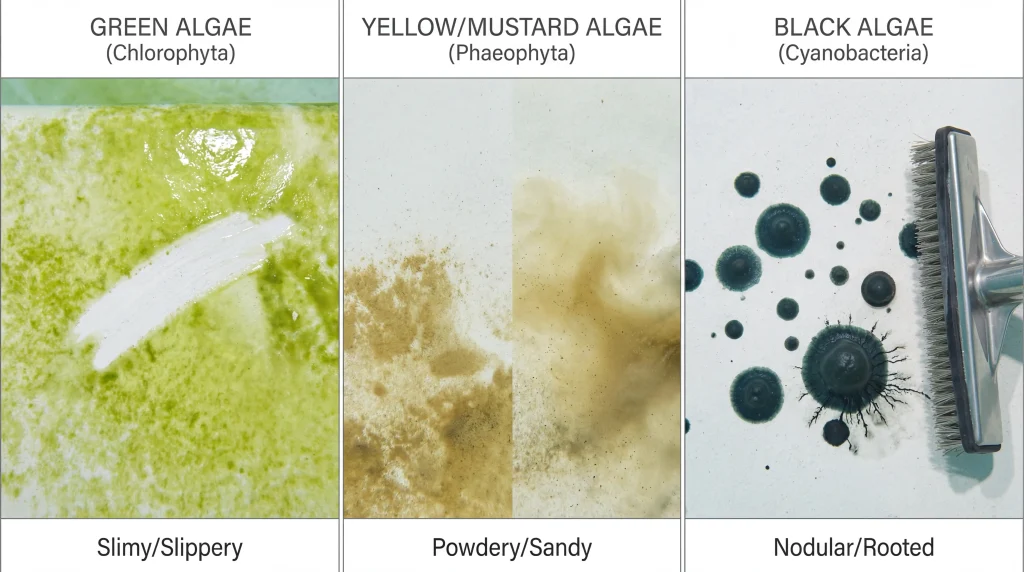
Not all algae behaves the same way. The three types you’ll encounter in Puerto Rico pools each require different approaches, and misidentifying what you’re dealing with means wasted time and chemicals.
Green Algae: The Most Common Invader
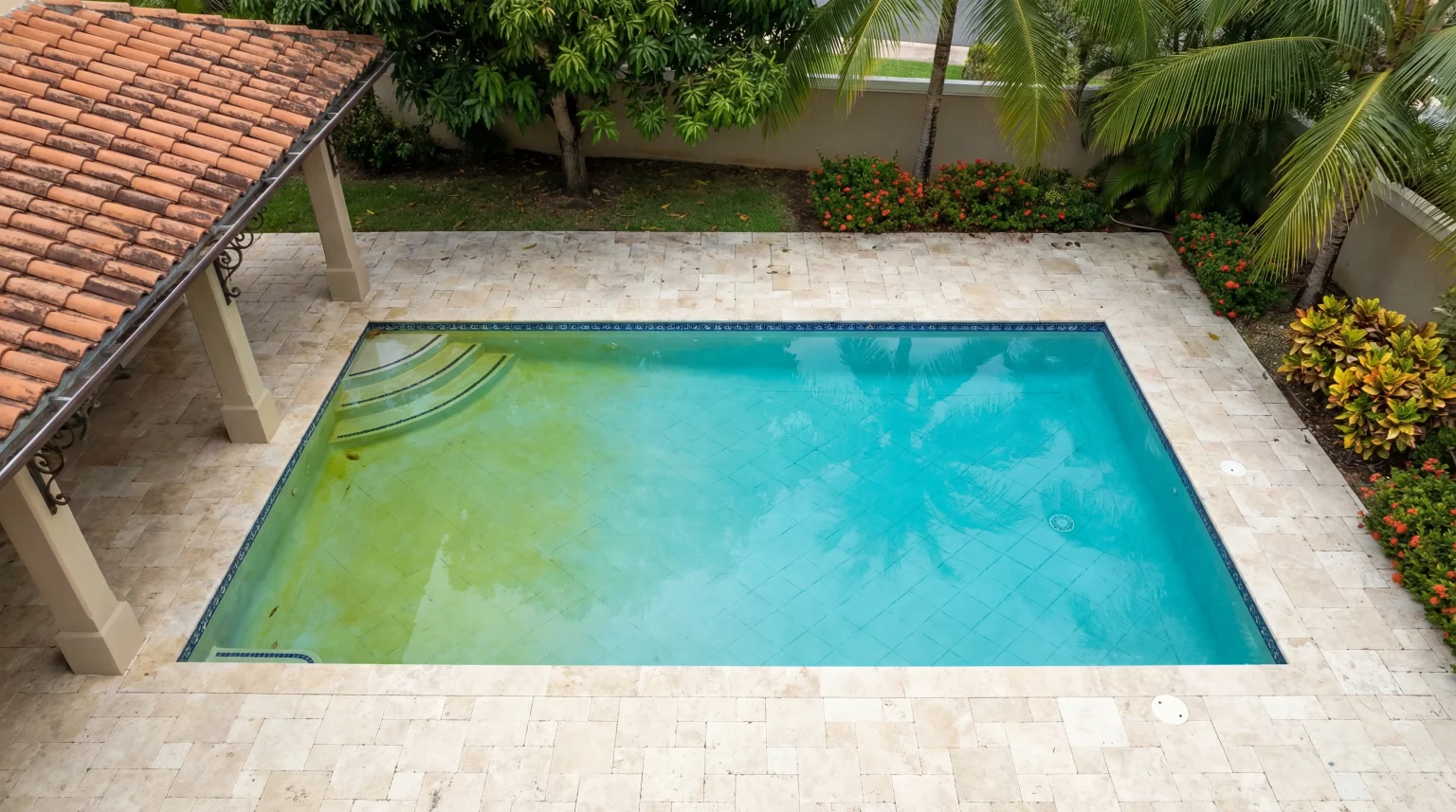
Green algae (Chlorophyta) is what most people picture when they think of pool algae. It ranges from a slight green tinge in the water to a full-on swamp appearance, and it can develop quickly—visible blooms within 24-48 hours when chlorine drops below effective levels.
The good news: green algae is the easiest type to treat. It responds to standard shock treatment and doesn’t have the chemical resistance of its cousins. The bad news: its speed means prevention matters more than treatment. By the time you see it, you’re already days behind.
Green algae typically indicates a straightforward problem—chlorine dropped, algae took advantage. If your pool repeatedly develops green algae despite regular service, the issue is usually inadequate chlorine levels, poor circulation, or CYA levels that have climbed too high.
Yellow (Mustard) Algae: The Chlorine-Resistant Problem
Yellow algae—sometimes called mustard algae—is rarer but significantly more frustrating. It appears as yellowish or brownish dust-like deposits, usually in shaded areas or corners with poor circulation. Many homeowners initially mistake it for dirt or pollen.
What makes yellow algae problematic is its chlorine resistance. Normal chlorine levels that would kill green algae barely affect it. It also has an annoying habit of hiding—in filter media, in pool cleaner internals, on swimsuits and pool toys—and reintroducing itself even after you think it’s gone.
Treating yellow algae requires triple-shock doses and often specialized algaecides. But more importantly, it requires treating everything the algae might have contacted: pool equipment, toys, and any swimsuits that were used in the infected water. Miss one contaminated item, and reinfection follows.
Black Algae: The Structural Threat
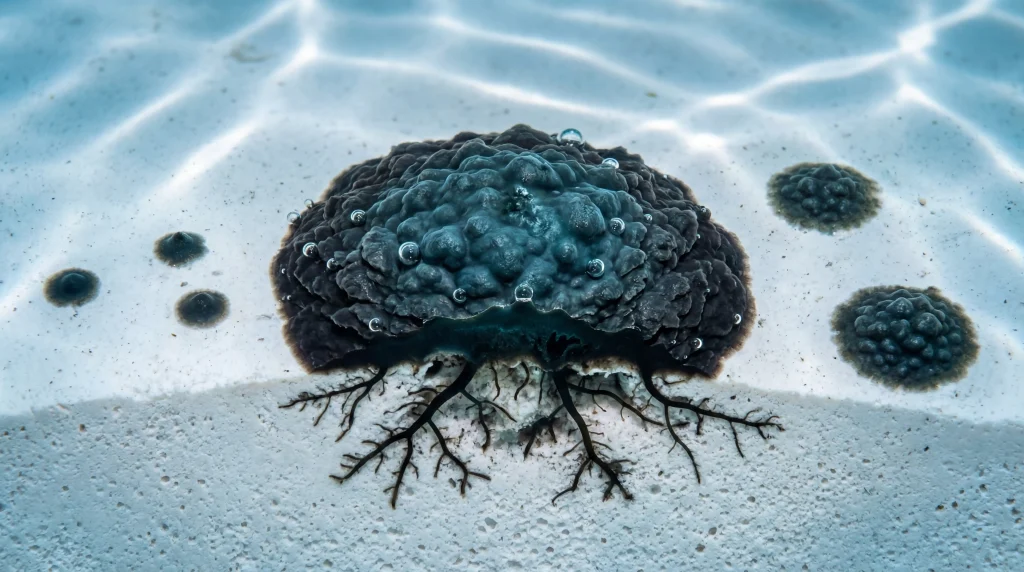
Black algae isn’t actually algae—it’s cyanobacteria, though the pool industry calls it black algae for convenience. It appears as dark black or blue-green spots, typically starting small and spreading if untreated.
Black algae is the most difficult to eliminate for two reasons. First, it develops a protective outer layer that shields it from sanitizers—you can’t just shock it away. Second, and more importantly, it grows roots. These roots penetrate into plaster, grout, and concrete, meaning surface treatment alone won’t kill it. Remove the visible growth without addressing the roots, and it returns.
Treatment requires aggressive brushing with a steel-bristled brush (for plaster pools) to break through the protective layer, followed by direct application of chlorine tablets or granules to the spots, combined with quadruple-shock levels maintained over multiple days. Even then, stubborn cases may return and require professional intervention.
If you’re seeing black algae repeatedly, it’s worth examining whether your pool surface has become porous enough to harbor persistent root systems—sometimes the long-term solution involves resurfacing.
What Causes Algae Growth
Algae needs three things to thrive: water, sunlight, and nutrients. You can’t eliminate the first two in a pool. But understanding the specific triggers helps target prevention.
Chlorine gaps matter more than averages. Your pool might average 3 ppm of free chlorine, but if it’s dropping to 0.5 ppm for six hours every afternoon before your equipment kicks in, that window is enough. Algae exploit gaps, not averages.
Circulation dead spots create sanctuaries. Areas with poor water movement—behind ladders, under steps, in corners far from return jets—allow algae to establish before chlorinated water reaches them. These spots need more brushing attention, not less.
Phosphates provide fuel. Phosphates don’t cause algae directly, but they’re a primary nutrient source. High phosphate levels mean algae can grow faster and recover more quickly from treatment. In Puerto Rico, phosphates enter your pool from rainfall runoff, decomposing organic matter, and sometimes even your tap water.
Storm events combine multiple problems. Heavy rain dilutes chlorine, introduces phosphates and debris, and adds algae spores simultaneously. Post-storm windows are highest risk for blooms.
The Phosphate Factor
Phosphate management gets overlooked by many pool owners, but it’s increasingly important in tropical conditions where algae pressure never lets up.
Phosphates are nutrients—specifically, compounds containing phosphorus that serve as biological building blocks. They enter your pool from fertilizer runoff, decaying leaves and organic matter, some pool chemicals, and even municipal water supplies (many water utilities add phosphate compounds for pipe corrosion control).
The target for pool phosphate levels is below 100 parts per billion (ppb). Above this threshold, you’re providing sufficient nutrients for algae to thrive even when chlorine levels are adequate. Think of it as giving algae a buffet—chlorine can kill what’s there, but new growth keeps coming because the food supply never runs out.
Testing for phosphates requires specific test kits (standard water tests don’t include them), and treatment involves phosphate removers that bind with phosphates and allow them to be filtered out. The key insight: treat phosphates after you’ve eliminated existing algae, not during an active bloom. Algae cells contain phosphates, so killing algae releases phosphates back into the water. Clear the algae first, then address the nutrient source.
Prevention vs. Treatment: Why Consistency Wins
Here’s the math that every Puerto Rico pool owner eventually learns:
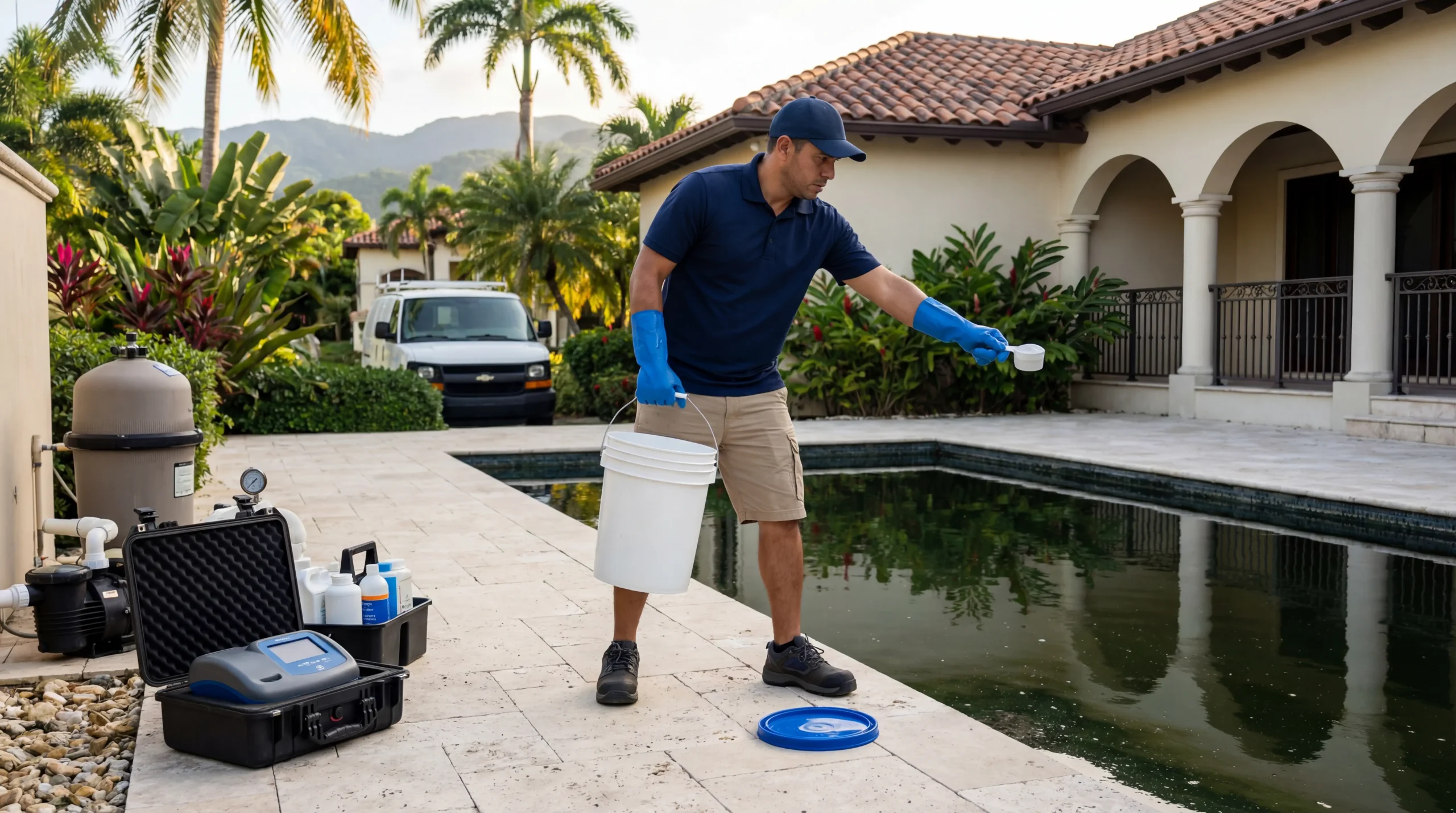
Recovering a green pool takes 3-7 days of intensive treatment, multiple shock applications, continuous filtration, repeated brushing and vacuuming, and often multiple filter cleanings. For a moderate bloom, you’re looking at $200-400 in chemicals and significant labor. Severe cases can cost more and take longer. The pool is unusable the entire time.
Prevention through consistent weekly service maintains proper chemistry, catches problems before they escalate, and keeps your pool swimmable. The weekly cost is a fraction of a single recovery event.
But here’s what makes this calculation different in Puerto Rico: on the mainland, you might get away with inconsistent maintenance because algae pressure varies seasonally. Here, that margin doesn’t exist. The week you skip is the week something goes wrong, and recovery in tropical conditions takes longer because growth never slows down.
This isn’t about selling you on more service—it’s about recognizing that the conditions here don’t forgive lapses the way temperate climates do.
What Effective Prevention Looks Like
Preventing algae in Puerto Rico pools requires more than just “keeping chlorine up.” Effective prevention includes:
Maintaining chlorine relative to CYA. Your free chlorine target depends on your cyanuric acid level. Higher CYA requires higher chlorine to maintain the same sanitizing power. If your CYA is at 60 ppm, you need to maintain 4-6 ppm of free chlorine—not the 1-3 ppm that mainland guidelines suggest.
Testing more frequently. In tropical conditions, 2-3 chemistry checks per week catches problems before they become visible. By the time you see green, algae has been growing for days.
Brushing systematically. Regular brushing prevents algae from establishing in surface pores and circulation dead spots. This is particularly important for plaster pools, which have microscopic texture that can harbor algae spores.
Managing phosphates proactively. Testing phosphate levels monthly—and after significant rainfall—keeps nutrient levels low enough that brief chlorine gaps don’t immediately result in blooms.
Responding to storms immediately. Post-storm testing and chemical adjustment within 24-48 hours prevents the combined effects of dilution, contamination, and nutrient loading from triggering blooms.
At Pristine Pools, we maintain pools throughout Palmas del Mar, Humacao, and Naguabo with protocols built for these conditions. When prevention works, you never need green pool recovery—which is exactly the point.
Frequently Asked Questions
Why does my pool keep getting algae even with regular service?
Recurring algae usually indicates one of three problems: chlorine levels that are technically “in range” but insufficient for your CYA level, circulation dead spots where algae can establish before treated water reaches them, or high phosphate levels providing nutrients that fuel rapid regrowth. A service that tests only weekly may miss brief chlorine gaps—in Puerto Rico’s conditions, those gaps matter more than they would in cooler climates. Ask about testing frequency, CYA management, and phosphate testing specifically.
What’s the difference between green and black algae?
Green algae is actual algae (Chlorophyta) that responds to standard chlorine treatment and indicates a straightforward chemistry problem. Black algae is cyanobacteria with a protective outer layer and root system that penetrates pool surfaces—it requires aggressive brushing to break through its defenses, direct chlorine application to affected spots, and sustained high chlorine levels over multiple days. Black algae also tends to return unless roots are fully eliminated, sometimes requiring professional treatment or surface repair.
Do I need to drain my pool if it has severe algae?
Draining is rarely necessary and introduces its own risks—empty pools can float or pop from groundwater pressure, and surfaces can be damaged by sun exposure. Most green pool situations, even severe ones, can be recovered through shock treatment, filtration, and vacuuming over 3-7 days. Draining might be considered for extreme black algae cases where root systems have penetrated deeply into deteriorated plaster, but this is a last resort that should include professional evaluation of structural conditions.
How do phosphates cause algae problems?
Phosphates don’t cause algae directly—they’re nutrients that algae use to grow. With high phosphate levels (above 100 ppb), algae can grow faster and recover more quickly after treatment because their food supply remains abundant. In Puerto Rico, phosphates enter pools from rainfall runoff, decomposing organic matter, and sometimes tap water. Testing and treating for phosphates—especially after clearing an algae bloom—helps prevent rapid recurrence by eliminating the nutrient source.
Can I prevent algae with algaecide alone?
Algaecide is a supplement, not a substitute for proper chlorine maintenance. It provides an additional layer of protection but cannot compensate for inadequate sanitizer levels, poor circulation, or high nutrient loads. The most effective algae prevention combines proper chlorine levels maintained relative to CYA, regular brushing and circulation, phosphate management, and algaecide as insurance—not as the primary defense. Relying on algaecide while neglecting fundamentals leads to recurring problems and wasted chemical expense.