You’ve probably heard the pitch: saltwater pools are gentler on your skin, require less maintenance, and save you money on chemicals. If you’re managing a pool in Puerto Rico—whether it’s your primary residence in Palmas del Mar, a vacation rental in Humacao, or a second home in Naguabo—you might be wondering if converting makes sense.
The short answer is that saltwater conversion works well for many Puerto Rico pool owners, but it comes with considerations specific to our tropical environment that most mainland advice doesn’t cover. After installing and servicing saltwater systems across eastern Puerto Rico for years, I can walk you through the real benefits, the actual costs, and the tropical-specific factors that affect whether this upgrade is right for your situation.
Let me be direct about something upfront: saltwater pools still use chlorine. The difference is how that chlorine gets there.
How Saltwater Pool Systems Actually Work
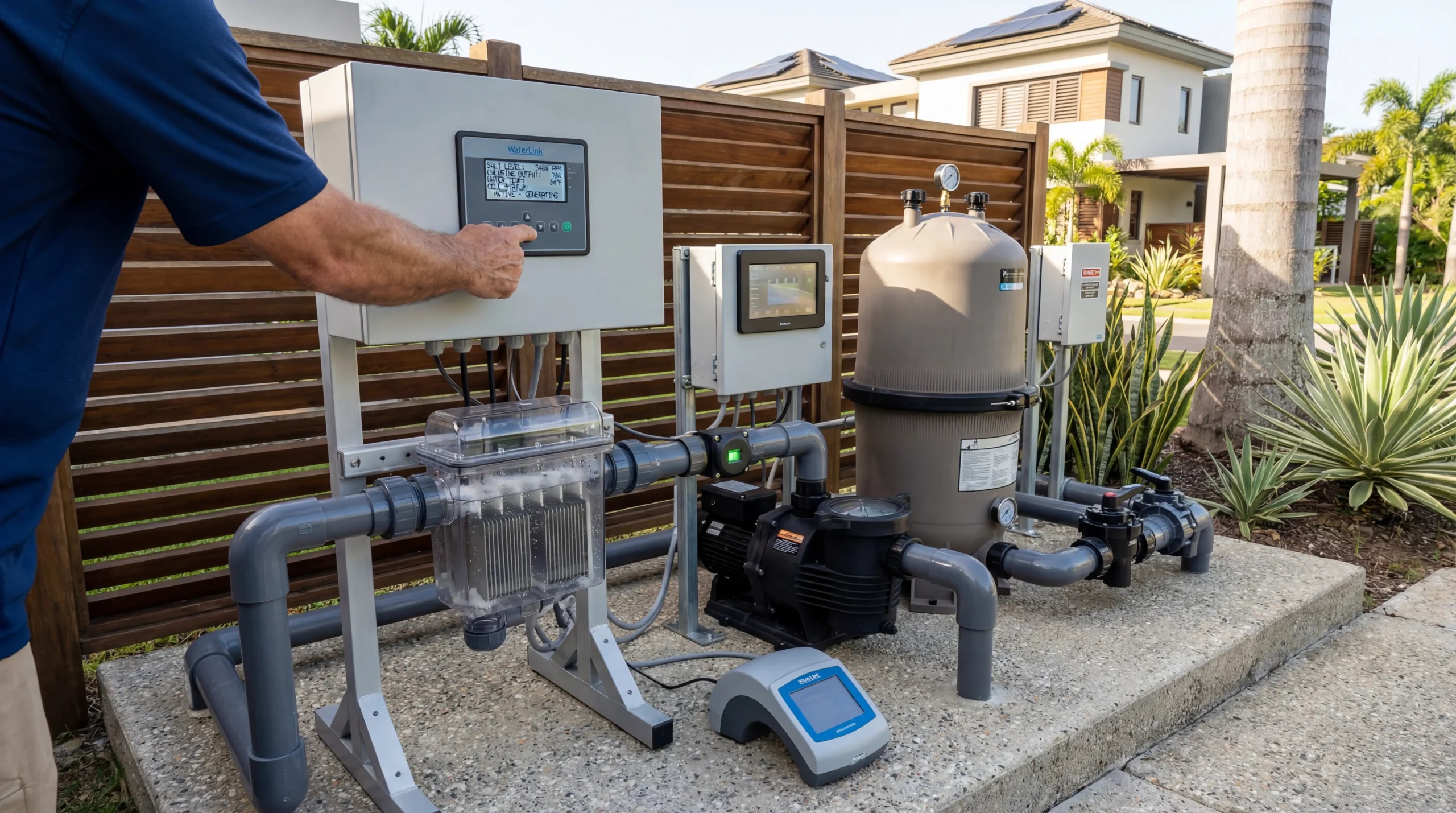
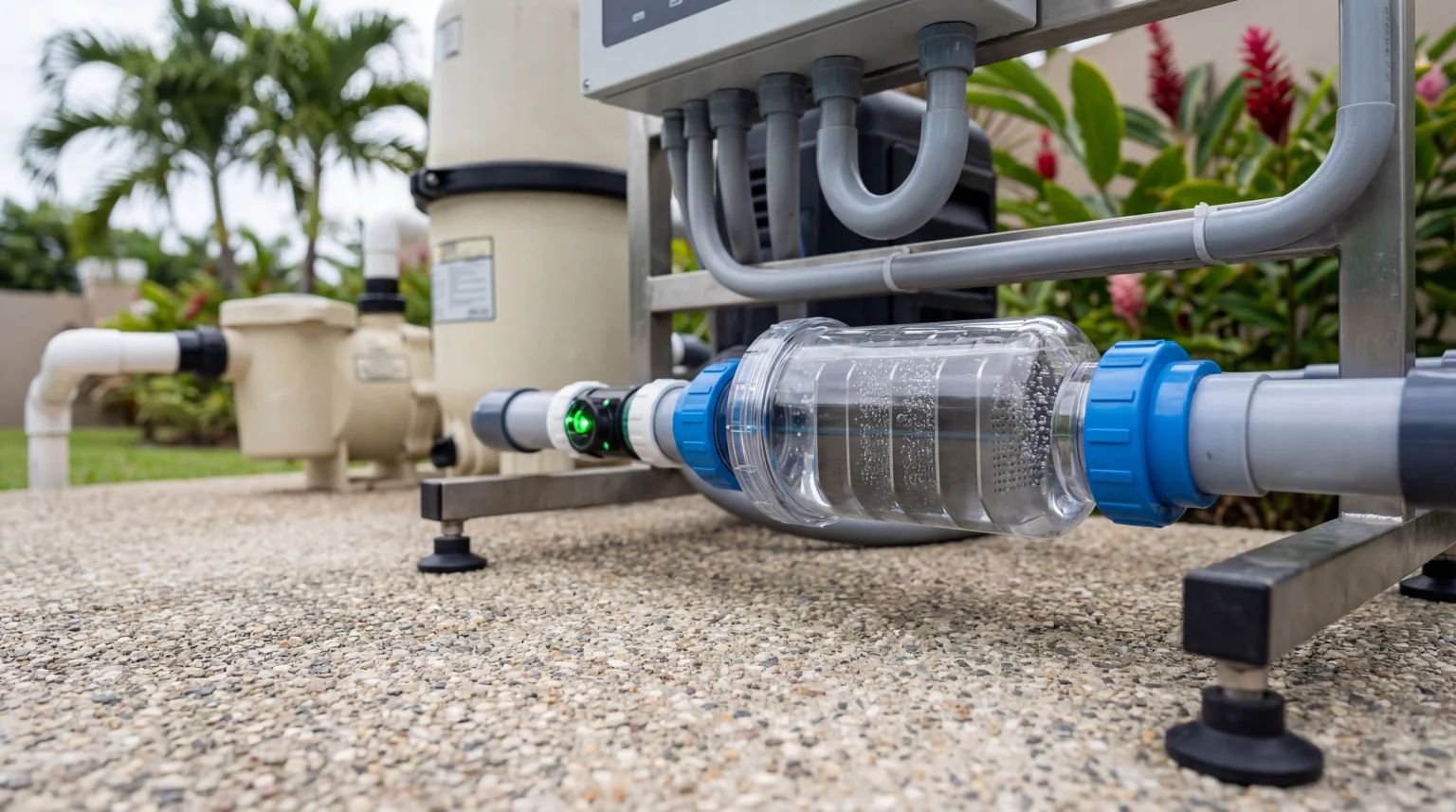
A salt chlorine generator (SCG) is essentially a miniature chlorine manufacturing plant attached to your pool’s plumbing. Here’s the process:
Pool-grade salt (sodium chloride, minimum 99.8% purity) is dissolved in your pool water at a concentration of 2,700-3,400 parts per million. That’s roughly one-tenth the salinity of ocean water—enough that the system works, but not enough that you’d notice the taste or feel like you’re swimming in the sea.
As water circulates through the salt cell, an electrical current passes through titanium plates coated with precious metals (typically ruthenium or iridium). This triggers electrolysis, which splits the salt molecules and generates hypochlorous acid—the same active sanitizer you get from traditional chlorine, just produced on-site instead of added manually.
The chlorine does its job killing bacteria and preventing algae, then converts back to salt through recombination. The cycle repeats continuously as long as the pump runs. You’re not constantly adding chlorine; the system generates it automatically from the salt that’s already in your water.
The Real Benefits of Saltwater Pools
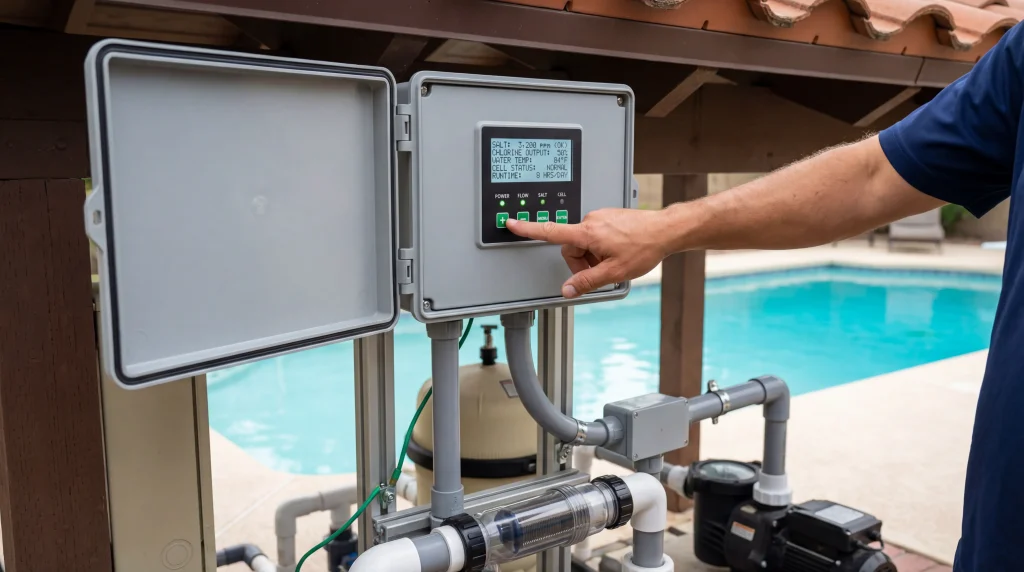
Let me separate the actual benefits from the marketing hype.
Gentler water quality is real. Traditional chlorine pools often have high chloramine levels—that’s the byproduct when chlorine reacts with sweat, oils, and other organic matter. Chloramines cause the “chlorine smell,” eye irritation, and that tight, dry feeling on your skin after swimming. Saltwater pools maintain steadier chlorine levels with fewer chloramine spikes, resulting in noticeably softer water that’s easier on eyes, skin, and hair.
Lower ongoing chemical costs are real—in Puerto Rico, significantly so. Mainland pool owners might save $300-400 annually. Here in Puerto Rico, where we swim year-round and intense UV burns through chlorine faster, the savings can reach $500-700 per year. You’re eliminating weekly chlorine purchases, shock treatments become less frequent, and algaecide use drops substantially.
Reduced chemical handling is real. No more lugging chlorine tablets or liquid chlorine, no more storing hazardous chemicals in your pool shed, no more bleached-out swim trunks from splashing during manual chlorination. For vacation rental properties where coordinating chemical deliveries between guests is a headache, automated chlorine generation is genuinely convenient.
“Maintenance-free” is not real. I’ll address this misconception directly: saltwater pools are easier to maintain than traditional chlorine pools, but they’re not maintenance-free. You still need pH monitoring (saltwater systems tend to raise pH over time), periodic salt level testing, quarterly cell cleaning, and all the normal filter and pump maintenance. The chemistry is simpler, not nonexistent.
What Saltwater Conversion Actually Costs
Conversion costs vary based on pool size, equipment quality, and installation complexity. Here’s what to expect in Puerto Rico:
Equipment costs:
- Salt chlorine generator (SCG) for 15,000-20,000 gallon pool: $1,200-$1,800
- Premium brands (Pentair IntelliChlor, Hayward AquaRite): $1,400-$2,000
- Generator should be sized 1.5-2x your actual pool volume for adequate headroom
Installation costs:
- Electrical work (dedicated 220V circuit): $300-$500
- Plumbing integration (cutting in cell, unions, flow sensor): $150-$300
- System commissioning and owner training: $100-$150
Initial salt:
- Approximately 200 pounds per 10,000 gallons for initial conversion
- Food-grade pool salt: $15-$20 per 40-lb bag
- 15,000-gallon pool: roughly $120-$180 in salt
Total conversion cost for typical 15,000-20,000 gallon inground pool: $1,700-$2,500
The break-even point—where chemical savings equal your initial investment—typically comes at 3-4 years for Puerto Rico pools, faster than mainland estimates because our year-round usage amplifies the savings.
The Conversion Process: What to Expect
A professional saltwater conversion in Puerto Rico follows this sequence:
Pre-Installation Assessment (1-2 hours)
Before committing to conversion, we assess your existing equipment for compatibility. Specifically, we’re checking:
- Pump flow rate: Salt cells require adequate water flow (typically 30+ GPM) to operate. Some older single-speed pumps may trigger low-flow errors.
- Electrical capacity: Most salt systems need a dedicated 220V circuit. We inspect your electrical panel for spare breaker capacity.
- Plumbing configuration: The cell installs downstream of the filter but before the heater. We verify there’s adequate space and access.
- Metal component inventory: Salt is corrosive to certain metals. We identify any brass fittings, galvanized pipes, or steel components that may need monitoring or replacement.
- Heater compatibility: Some older copper heat exchangers corrode rapidly from salt exposure. Cupro-nickel exchangers handle saltwater fine.
If your equipment passes assessment, we proceed. If upgrades are needed, we factor those into your quote—no surprises after installation starts.
Installation Day (4-6 hours)
A licensed electrician runs the dedicated circuit from your main panel to the equipment pad, installs a waterproof junction box, and connects the control unit. We verify proper grounding and GFCI protection per code.
We cut into your return line downstream of the filter, install unions flanking the salt cell location (allowing easy removal for maintenance), mount the cell housing, connect the flow sensor, and pressure test for leaks.
The control unit mounts on the wall near your equipment with clear display visibility. We complete all system wiring, connecting the cell to the control unit and optionally integrating with your pool automation system if you have one.
Finally, we add salt by spreading it evenly around the pool perimeter while brush-assisting dissolution. The pump runs continuously for 24 hours to distribute and dissolve the salt before system activation.
Commissioning (Day 2, 1-2 hours)
We return the following day for comprehensive water chemistry balancing and system startup:
- Verify salt level has reached target range (2,700-3,400 ppm via digital testing)
- Adjust pH to 7.4-7.6 (saltwater systems push pH higher over time)
- Balance alkalinity to 80-100 ppm
- Set cyanuric acid to 60-80 ppm (higher than traditional pools, compensating for continuous chlorine generation and Puerto Rico’s UV intensity)
- Activate salt cell at appropriate output setting (typically 50-60% for initial operation)
- Test free chlorine after 24 hours to verify adequate production
- Adjust output percentage as needed
You receive complete training on control panel operation, monthly cell cleaning procedures, salt level monitoring, and routine chemistry testing. We provide documentation including equipment manuals, warranty registration, and our maintenance schedule recommendations.
Tropical Considerations: What’s Different in Puerto Rico
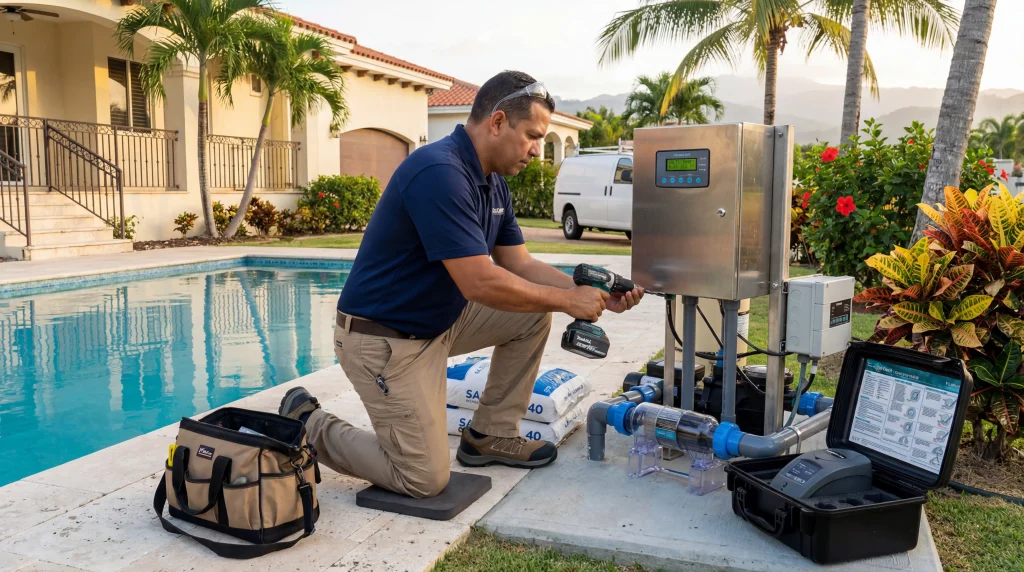
Most saltwater conversion advice comes from mainland sources that don’t account for Puerto Rico’s unique conditions. Here’s what actually matters here:
Year-round operation maximizes benefits—and equipment wear. You’re using your pool 12 months instead of 5-6, which amplifies chemical cost savings but also means more operating hours on the salt cell. Where mainland cells often last 5-7 years, Puerto Rico cells may see 3-5 years depending on maintenance. Budget for cell replacement ($600-$1,000) accordingly.
Higher chlorine demand requires proper sizing. Our water temperatures regularly exceed 85°F, and elevated temperatures increase chlorine consumption 2-3x compared to cooler pools. This is why we recommend oversizing your generator by 1.5-2x—a 15,000-gallon pool should have a generator rated for 25,000-30,000 gallons. Running the cell at 50% output is easier on the equipment than constantly running at 100%.
UV intensity affects cyanuric acid management. Puerto Rico’s UV index of 10-12 degrades chlorine rapidly. Saltwater pools here need CYA levels in the 60-80 ppm range rather than the 30-50 ppm often recommended elsewhere. Higher CYA protects the chlorine your system generates from immediate UV destruction.
Salt air is already here—but corrosion still matters. Coastal Puerto Rico already has salt-laden air corroding metal fixtures. Adding saltwater to your pool won’t dramatically change your exterior metal situation, but it does affect pool equipment components. Stainless steel, plastic, and cupro-nickel components handle saltwater fine; brass and galvanized metals may need replacement or monitoring.
Humidity affects electronic controls. The control unit should be mounted in a location with some protection from direct rain and maximum humidity. Under a covered equipment pad is ideal; exposed equipment pads may benefit from a weatherproof enclosure.
Power outages require attention. When your pump isn’t running, the salt cell isn’t producing chlorine. After extended power outages (common during hurricane season), you may need manual chlorine addition to prevent algae growth while the system catches up.
Ongoing Saltwater Pool Maintenance
Here’s what maintenance actually looks like after conversion:
Weekly (same as traditional pools):
- Test pH and adjust as needed (saltwater systems tend to raise pH)
- Test free chlorine and verify adequate production
- Skim, brush, vacuum as needed
- Check and empty skimmer baskets
Monthly:
- Test salt level and adjust if needed (evaporation concentrates salt; rainfall dilutes it)
- Test cyanuric acid level
- Inspect salt cell for visible scale buildup
Quarterly (every 3 months):
- Clean salt cell by removing and soaking in diluted muriatic acid (4:1 water-to-acid ratio) to remove calcium scale
- Inspect cell plates for wear, pitting, or coating degradation
- Verify flow sensor operation
Annually:
- Complete water chemistry panel including calcium hardness and total dissolved solids
- Professional system inspection
- Verify control unit operation and cell hour tracking
The biggest maintenance mistake? Over-cleaning the cell. Acid cleaning should only happen when you actually see calcium scale buildup on the plates. Unnecessary acid exposure accelerates plate coating wear and shortens cell life. Inspect monthly; clean only when needed.
When Saltwater Conversion Doesn’t Make Sense
I want to be straightforward about situations where conversion isn’t the best investment:
If you’re selling the property within 2 years: You won’t reach break-even on your investment, and saltwater systems aren’t necessarily a selling point for all buyers.
If your existing equipment needs major work: Upgrading to saltwater while your pump is failing or your electrical panel needs replacement compounds costs. Address infrastructure first.
If you have extensive brass or galvanized components: Some older pools have brass fittings, galvanized pipes, or steel walls that corrode rapidly in saltwater. Complete component replacement may exceed the value of conversion.
If you prefer hands-off ownership and minimal involvement: Saltwater pools still need attention—less than traditional chlorine, but not zero. If you want to never think about your pool, weekly professional service (whether saltwater or traditional) is your answer, not conversion alone.
If cost is the only driver and you already have reliable service: The savings are real but take years to materialize. If your current setup works well, conversion is a convenience upgrade, not a necessity.
Finding Saltwater Expertise in Puerto Rico
Here’s a reality of the Puerto Rico pool service market: many providers have limited experience with saltwater systems. Converting a pool is straightforward for someone who’s done it dozens of times; it’s easy to misconfigure for someone figuring it out on the job.
Questions to ask any provider offering saltwater conversion:
- How many systems have you installed in the past two years?
- What brands do you work with, and why?
- How do you size the generator for tropical conditions?
- What’s your process for equipment compatibility assessment?
- Do you provide cell cleaning training or is that an ongoing service?
- What warranty do you offer on installation work?
At Pristine Pools, we’ve installed and maintain saltwater systems throughout Palmas del Mar, Humacao, Naguabo, and eastern Puerto Rico. We can assess your existing equipment, recommend appropriate generator sizing for our tropical conditions, handle the complete installation including electrical work, and train you on proper maintenance—or include saltwater-specific maintenance in your ongoing service plan.
If you’re considering conversion, we’re happy to evaluate your pool and provide a detailed quote with no obligation. For some pools, saltwater is the obvious upgrade. For others, traditional chlorine with good service makes more sense. We’ll tell you which applies to yours.
Frequently Asked Questions
How much does it cost to convert a pool to saltwater in Puerto Rico?
Complete saltwater conversion for a typical 15,000-20,000 gallon inground pool costs $1,700-$2,500 in Puerto Rico. This includes the salt chlorine generator ($1,200-$2,000 depending on size and brand), electrical installation ($300-$500 for dedicated 220V circuit), plumbing integration ($150-$300), initial salt ($120-$180), and system commissioning with owner training. Premium systems and larger pools cost more; above-ground pools typically cost less.
Are saltwater pools really chlorine-free?
No—saltwater pools still use chlorine for sanitation. The difference is how chlorine gets into the water. Instead of manually adding chlorine tablets or liquid, a salt chlorine generator produces chlorine automatically through electrolysis of dissolved salt. The result is steadier chlorine levels with fewer spikes, which creates gentler water with less chloramine irritation, but chlorine is still the active sanitizer.
How long does a salt cell last in Puerto Rico’s climate?
Salt cells in Puerto Rico typically last 3-5 years compared to 5-7 years on the mainland. Year-round pool use means more operating hours on the cell, and elevated water temperatures increase chlorine demand, requiring higher cell output. Proper sizing (1.5-2x pool volume), regular maintenance, and avoiding unnecessary acid cleaning extend cell life. Budget $600-$1,000 for cell replacement every 3-5 years.
Does saltwater damage pool equipment?
Salt is corrosive to certain metals including brass, galvanized steel, and some copper alloys. Stainless steel, plastic, and cupro-nickel components handle saltwater well. During pre-installation assessment, we identify any incompatible components—typically older heater heat exchangers, brass fittings, or galvanized pipes—that may need replacement or monitoring. Properly configured systems don’t cause equipment damage.
Is saltwater pool maintenance really easier than chlorine pools?
Saltwater pools are easier to maintain but not maintenance-free. You eliminate weekly chlorine additions and reduce chemical handling, but you still need pH monitoring (saltwater raises pH over time), periodic salt level testing, quarterly cell cleaning to remove calcium scale, and normal filter/pump maintenance. The chemistry is simpler and more stable, which reduces intervention frequency, but regular attention is still required for optimal water quality.