You came back from two weeks in Miami and your pool looks like a swamp. The water’s so dark you can’t see the shallow end steps. There’s a thick green film on the walls. Maybe you’re wondering if the whole thing needs to be drained and started from scratch.
Here’s the good news: in most cases, your pool can be recovered without draining. The process takes anywhere from 24 hours for a light green tint to 7-10 days for severe black-green contamination—but it’s almost always salvageable. I’ve transformed pools that looked like abandoned ponds back into crystal-clear water, and I can explain exactly how that process works.
What makes Puerto Rico different? Pools here turn green faster than anywhere on the mainland. Water temperatures stay in the 82-87°F range year-round, creating ideal algae growth conditions 365 days a year. Combine that with a UV index that regularly hits 10-12, which destroys unprotected chlorine in 2-3 hours, and you’ve got a recipe for rapid algae colonization the moment chemical levels drop.
Why Puerto Rico Pools Turn Green So Fast
If you’re coming from Texas, Florida, or California, you might be surprised how quickly things can go wrong here. There’s a reason for it.
Algae are single-celled photosynthetic organisms that exist naturally in the environment—they’re carried by wind, rain, swimmers, and pretty much everything else that touches your pool. In temperate climates, cold winter temperatures create a dormant period where algae growth slows dramatically. Puerto Rico doesn’t have that.
Water temperature is the accelerant. Algae growth rates roughly double with every 10°F increase above 60°F. When your pool water sits at 85°F—pretty standard here from April through November—you’re operating at maximum algae growth potential. Miss two weeks of proper chlorination, and you’ll come home to a green pool.
The UV factor compounds the problem. Puerto Rico’s equatorial position means intense ultraviolet radiation that breaks down chlorine molecules rapidly. Without adequate cyanuric acid (CYA) stabilizer in the 50-70 ppm range, free chlorine doesn’t last long enough to suppress algae between service visits. This is why pools here need more frequent chemical attention than mainland recommendations suggest.
Then there’s rainfall. Afternoon storms are common in Puerto Rico, especially during summer months. Rain itself is slightly acidic (around pH 5.0 compared to your target 7.4-7.6), and each storm dilutes your chlorine while depositing organic debris, dirt, and—yes—algae spores directly into the water. A heavy rain event followed by three sunny days with no service is exactly how many green pool situations start.
Understanding Green Pool Severity Levels
Not all green pools are created equal. The severity determines the recovery timeline, chemical requirements, and whether you can realistically handle it yourself or need professional intervention.
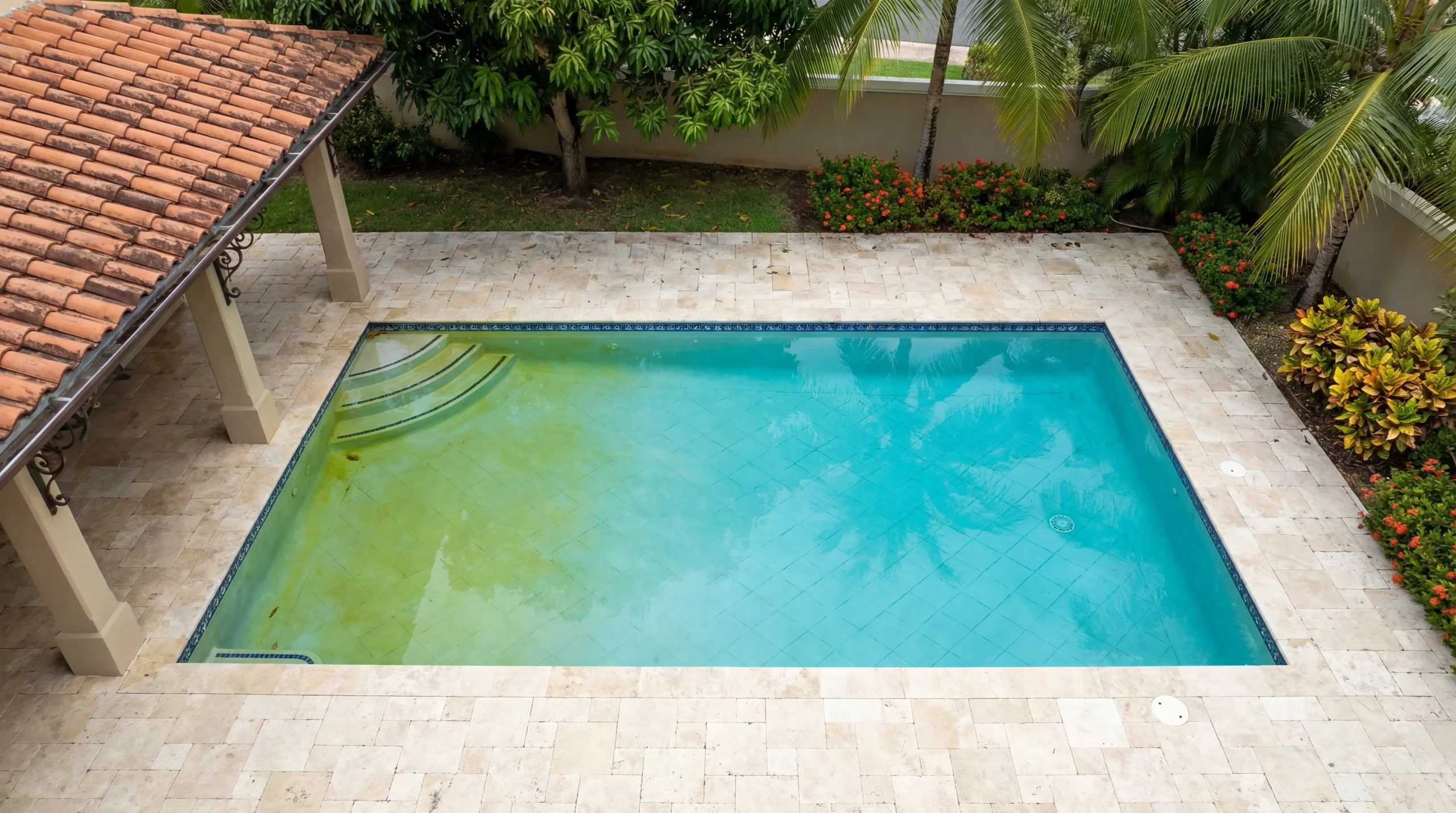
Light Green (G1): The water has a slight green tint, but you can still see the pool floor clearly, including the main drain and any light fixtures. The walls may feel slightly slippery. This typically results from 3-7 days of inadequate chlorine maintenance. Recovery timeline is 24-48 hours with proper treatment. DIY is feasible if you have the right chemicals and equipment.
Moderate Green (G2): Water appears murky green with the floor barely visible. You can make out the general shape of the deep end but not specific features. Walls have noticeable algae buildup. This usually means 1-2 weeks of chlorine depletion and established algae colonies. Recovery takes 2-4 days and requires aggressive treatment protocols. Professional service recommended to avoid equipment strain and chemical miscalculation.
Dark/Heavy Green (G3): The water is opaque—you cannot see more than a few inches below the surface. Thick algae coat all surfaces. This represents 3-4+ weeks of neglect with heavy algae biomass throughout the water column. Recovery requires 4-7 days of intensive treatment with multiple visits, continuous filtration, and careful management of filter pressure. Professional service essential.
Black/Swamp (G4): Pool resembles a stagnant pond with black or extremely dark green coloration. Neither light fixtures nor floor visible. Substantial debris accumulation, possibly mosquito larvae. At this point, chemical treatment alone may take 1-2 weeks, and in some cases, drain-and-acid-wash is actually faster and more cost-effective. Professional assessment required.
The key diagnostic is visibility. If you can see the main drain, you’re probably looking at a DIY-recoverable situation. If you can’t see the first step in the shallow end, call a professional.
The Green Pool Recovery Process: What Actually Happens
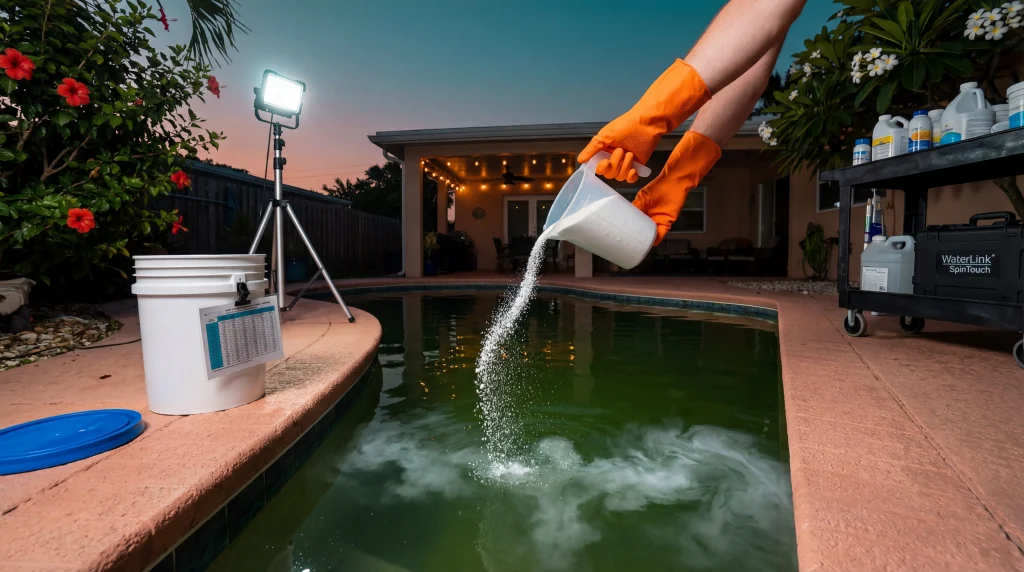
Recovery isn’t mysterious—it’s systematic chemistry and physical cleaning, applied correctly and in the right sequence. Here’s what a professional recovery looks like:
Step 1: Equipment Assessment and Debris Removal
Before adding any chemicals, we verify that the pump, filter, and circulation system are functional. There’s no point shocking a pool if the water isn’t moving. We also remove large floating debris—leaves, branches, whatever blew in—using heavy-duty leaf rakes and deep-bag skimmers. This debris would otherwise consume chlorine and clog the filtration system.
Step 2: Initial Shock Treatment
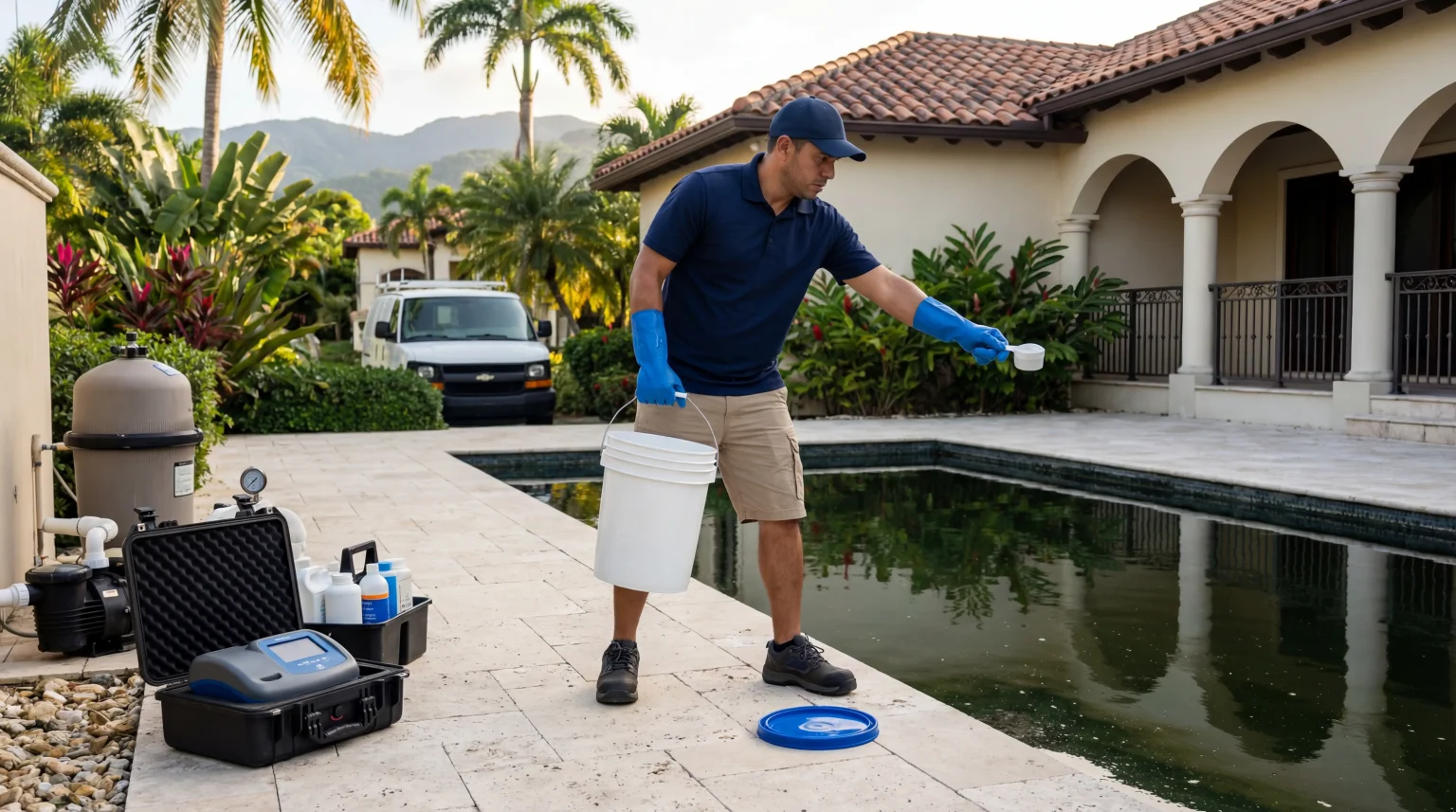
“Shocking” means raising free chlorine to levels high enough to overwhelm and kill algae—typically 20-30 ppm for moderate green pools, compared to the normal 3-5 ppm operating range. For a standard 15,000-gallon residential pool, this might mean 5-10 gallons of liquid sodium hypochlorite or 5-10 pounds of granular calcium hypochlorite.
We add shock in the evening because sunlight degrades chlorine before it can do its work. The pump runs continuously—24 hours a day—until recovery is complete.
Step 3: Aggressive Brushing
Algae cling to pool surfaces, and the outer layer of algae colonies can actually protect interior cells from chlorine contact. Aggressive brushing breaks up these colonies, suspends algae in the water column where chemicals can attack, and loosens buildup from walls, floors, steps, and behind ladders. This is labor-intensive but essential.
Step 4: Algaecide Application
After shocking, we add an appropriate algaecide. Different algae types respond to different formulations: copper-based algaecides work well on green algae, while quaternary ammonium compounds are more effective on yellow (mustard) algae. The algaecide helps prevent surviving spores from re-establishing once chlorine levels drop.
Step 5: Filter Management
Here’s where things get tricky. As algae die, they turn gray or white and settle into fine particles throughout the water. Your filter is now working overtime to remove this dead organic matter—and filter pressure climbs rapidly.
For sand and DE filters, backwashing may be required every few hours during active recovery. For cartridge filters, we remove and rinse the cartridge repeatedly, sometimes multiple times per day. If filter pressure spikes too high (generally 8-10 PSI above baseline), circulation suffers and recovery stalls.
Step 6: Vacuuming and Clarification
Once the water begins transitioning from green to gray/milky, we vacuum dead algae off the pool floor—ideally to “waste,” bypassing the filter entirely if your system allows. For stubborn cloudiness, a clarifier or flocculant helps coagulate fine particles so filtration can remove them.
Step 7: Testing and Rebalancing
After algae are eliminated and water clears, we test and adjust pH (target 7.4-7.6), total alkalinity (80-120 ppm), and verify chlorine has returned to normal operating range (3-5 ppm). CYA levels are checked to ensure ongoing UV protection—this is often how the problem started in the first place.
Recovery Timeline: Setting Realistic Expectations
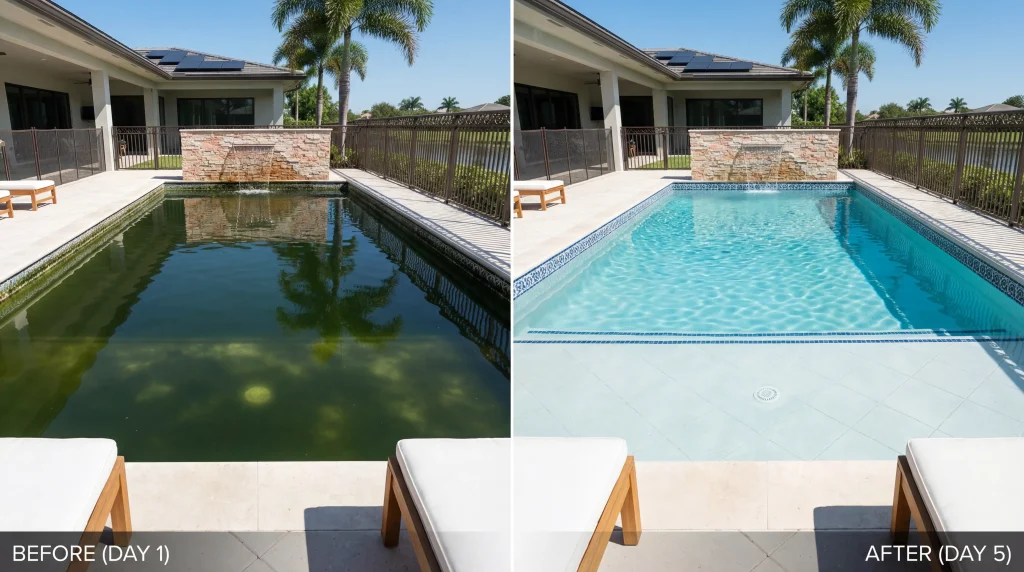
I want to be direct about this because many pool owners have unrealistic expectations: green pool recovery is not an overnight process. Companies that promise “green to clean in 24 hours” for anything beyond a light G1 situation are either oversimplifying or cutting corners.
Here’s what’s realistic:
- Light green (G1): 24-48 hours with single shock treatment and continuous filtration
- Moderate green (G2): 3-5 days, typically requiring 2-3 professional visits
- Dark green (G3): 5-7 days, requiring 3-4+ visits with intensive filter management
- Black/swamp (G4): 7-14 days for chemical recovery, or drain-and-acid-wash may be faster
Factors that extend timeline include inadequate filtration capacity, undersized pump, heavy organic debris load, and weather (additional rain during treatment dilutes chemicals and reintroduces contaminants).
DIY vs. Professional Recovery: Making the Right Call
Can you fix a green pool yourself? It depends on severity and what you’re working with.
DIY is reasonable for G1 (light green) situations if you have:
- Functioning pump and filter system
- Test kit (strips aren’t accurate enough—use liquid reagent or photometric)
- Granular shock and algaecide (not just regular chlorine)
- Pool brush and vacuum
- Several hours over 2-3 days for monitoring and filter maintenance
Call a professional for G2+ situations because:
- Chemical dosing errors are common and can damage pool surfaces
- Filter pressure management requires experience—clogging a filter during recovery can burn out your pump
- Professional-grade chemicals work faster than retail products
- We have equipment for vacuuming to waste, which most homeowners don’t
- Time investment exceeds what most people anticipate
Professional green pool recovery in Puerto Rico typically runs $200-400 for moderate cases and $400-600+ for severe situations requiring multiple visits. That includes chemicals, labor, and equipment—which compares favorably to DIY chemical costs of $100-200 plus significant time investment and risk of extended problems if something goes wrong.
Understanding Algae Types
While green algae is most common, you may encounter other varieties that require modified treatment:
Green Algae (Chlorophyta): The most common and easiest to treat. Appears as green water, slimy walls, or both. Responds well to standard shock and copper-based algaecides. Most green pool situations involve this type.
Yellow/Mustard Algae: Appears as yellowish-brown dust on walls and floor, often in shaded areas. Brushes off easily but returns quickly. It’s chlorine-resistant, meaning normal shock levels don’t kill it. Requires higher chlorine concentrations (triple-shock) and specific yellow algae treatment products. Also contaminates pool toys, floats, and anything that touches the water.
Black Algae (Cyanobacteria): Technically bacteria, not true algae. Appears as small black or dark blue-green spots, usually on plaster or gunite surfaces. Has protective layers and root structures that penetrate porous surfaces. Extremely difficult to eliminate—requires quadruple-shock, aggressive steel-bristle brushing (for plaster pools), and often multiple treatment cycles. If you have black algae, you need professional help.
Preventing Green Pool Recurrence
Recovery is expensive and disruptive. Prevention is cheaper and simpler. Here’s what actually prevents green pools in Puerto Rico’s climate:
Maintain consistent chlorine levels. Free chlorine should stay in the 3-5 ppm range at all times. In tropical conditions, this often means more frequent testing than mainland recommendations suggest—we test every visit, which is typically weekly.
Keep CYA (cyanuric acid) in the 50-70 ppm range. This stabilizer protects chlorine from UV degradation. Too low, and chlorine burns off in hours. Too high (above 100 ppm), and chlorine becomes less effective. Annual partial drain-and-refill helps manage CYA accumulation.
Run your pump adequately. The entire pool volume should turn over at least once daily—more in hot conditions. For a typical 15,000-gallon pool with a 1.5 HP pump, that’s roughly 6-8 hours of runtime. Insufficient circulation creates dead zones where algae establish.
Don’t skip service before travel. If you’re leaving for two weeks, make sure your pool is serviced immediately before departure and arrange for mid-trip service if possible. The combination of no chemical attention plus Puerto Rico heat is exactly how green pools happen.
Address problems early. If your pool feels slightly slippery or you notice a faint green tint, that’s the time to shock—not when it’s already dark green. Early intervention is vastly easier than full recovery.
What to Do When You Return to a Green Pool
Finding a green pool is frustrating, but here’s your immediate action plan:
- Don’t panic about draining. In 95% of cases, the pool is salvageable without drainage.
- Check equipment. Make sure the pump runs and filter pressure is normal. If equipment isn’t functional, address that first.
- Assess severity. Can you see the main drain? If yes, you’re in G1-G2 territory and recovery is straightforward. If the water is opaque, you’re in G3-G4 and professional help will save time and money.
- Don’t add random chemicals. Some homeowners dump in shock, algaecide, clarifier, and everything else they can find. This can create chemical conflicts and extend recovery time.
- Contact a professional. At Pristine Pools, we can typically assess severity over the phone or via photos and provide a clear timeline and cost estimate before we arrive.
Green pools happen—especially in Puerto Rico. But with the right approach, recovery is systematic, predictable, and gets you back to enjoying your pool within days, not weeks.
Frequently Asked Questions
How long does it take to clear a green pool in Puerto Rico?
Recovery timeline depends on severity. Light green pools with visible floor typically clear in 24-48 hours with proper shock treatment and continuous filtration. Moderate green pools require 3-5 days with professional treatment. Severely contaminated pools—where you cannot see below the surface—may take 5-10 days of intensive treatment including multiple shock applications, aggressive brushing, and careful filter management.
Can you fix a green pool without draining it?
Yes, in approximately 95% of cases. Chemical treatment—shock chlorination combined with algaecide, aggressive brushing, and filtration—restores most green pools without draining. The exceptions are extreme cases where the pool resembles a black pond with years of neglect, or where you need surface repair via acid washing anyway. Draining also carries risks including groundwater pressure damage to pool structure.
Why did my pool turn green after just two weeks away?
Puerto Rico’s tropical conditions create perfect algae growth environments year-round. Water temperatures of 82-87°F support maximum algae reproduction, while intense UV radiation (index 10-12) degrades unprotected chlorine in 2-3 hours. Without chemical maintenance for 10-14 days, chlorine depletes completely, and algae that are always present in microscopic quantities bloom rapidly in the warm, nutrient-available water.
How much does green pool recovery cost in Puerto Rico?
Professional green pool recovery typically costs $200-400 for moderate cases (G2) requiring 2-3 visits over 3-5 days. Severe cases (G3-G4) requiring intensive multi-visit treatment range $400-600+. Pricing includes chemicals, labor, and equipment. DIY chemical costs run $100-200 for moderate cases, though homeowners often extend recovery time through incorrect dosing or filter management.
What’s the difference between green algae and black algae treatment?
Green algae responds to standard shock treatment and copper-based algaecides, typically clearing with 2-3x normal chlorine concentration. Black algae is actually cyanobacteria with protective outer layers and root structures that penetrate pool surfaces—it requires quadruple-shock concentration, aggressive steel-bristle brushing to break protective layers, specialized algaecides, and often multiple treatment cycles. Black algae is significantly more difficult and time-consuming to eliminate.